The Ultimate Guide to 0-85 Brix Refractometer in the UK
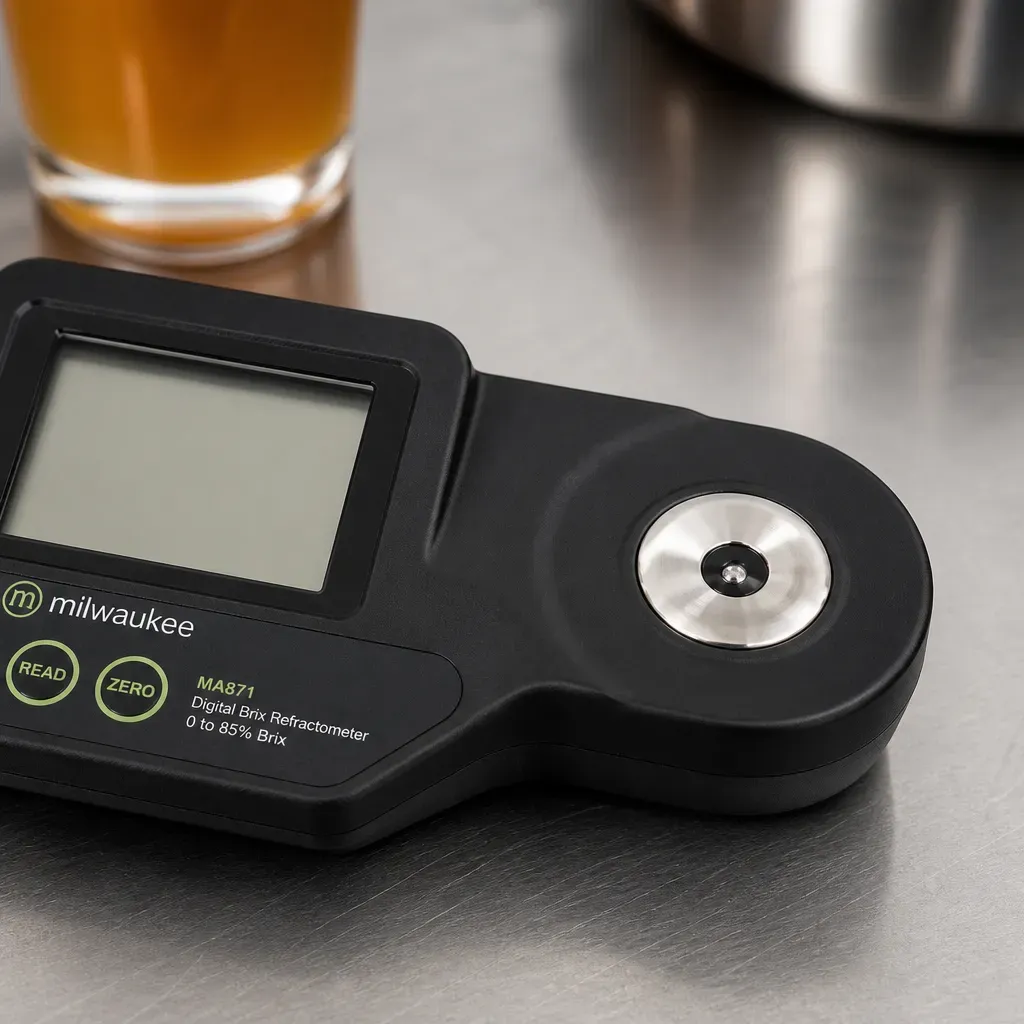
A few points of sugar concentration can decide whether a batch is accepted, adjusted or written off. In food production, beverage preparation, laboratory work and quality control, speed matters, but so does confidence in the reading. That is why the 0-85 Brix refractometer remains a practical standard across the UK: it covers a broad working range, supports fast decisions and gives operators a direct measure they can use on the spot.
For teams that need dependable results without the delay of subjective interpretation, a digital Brix refractometer offers a clear advantage. Milwaukee D’s approach is built around that need: a digital Brix refractometer for faster, more reliable QC, with a professional 0-85 Brix range, automatic temperature compensation and clear digital readings that reduce guesswork at the point of use.
Key Takeaways
- A 0-85 Brix refractometer measures the percentage of dissolved sugars in liquids across a wide and highly practical range.
- It is widely used in UK food, drink and laboratory settings for incoming goods checks, in-process control and final product verification.
- Digital models with ATC help improve consistency by compensating for temperature changes that can affect readings.
- Clear digital results reduce operator interpretation errors compared with traditional optical scales.
- Routine calibration, proper sample handling and regular cleaning are essential for trustworthy results.
- For many British businesses, a 0-85 Brix instrument is the most versatile choice because it covers low, medium and high sugar products in one device.
What is a 0-85 Brix refractometer?
A 0-85 Brix refractometer is an instrument designed to measure the concentration of dissolved solids, primarily sugars, in a liquid sample. The result is expressed in degrees Brix, where 1 degree Brix broadly represents 1 gram of sucrose in 100 grams of solution. In practical terms, it gives a quick indication of sweetness, concentration and batch consistency.
The 0-85 Brix range is especially useful because it spans everything from relatively dilute solutions to much denser syrups and concentrates. That makes it a strong fit for British manufacturers, craft beverage producers, food development teams, wholesalers, caterers and technical users who do not want multiple narrow-range instruments.
Although Brix is rooted in sucrose measurement, refractometers are commonly used as a practical proxy for soluble solids in many products. In real-world quality control, this helps teams monitor formulation consistency, check dilution, verify incoming ingredients and identify deviations early.
Why the 0-85 range matters
A narrower meter can work well in a single-use environment, but many UK businesses handle more than one product category. A 0-85 Brix refractometer provides flexibility for:
- Fruit juices and cordials
- Soft drinks and syrups
- Jams, preserves and fruit preparations
- Honey and sweet sauces
- Food research and development samples
- Laboratory verification of sugar concentration
This breadth is one reason the 0-85 Brix format is often considered the practical all-rounder for commercial use.
How a 0-85 Brix refractometer works
A refractometer works by measuring how light bends, or refracts, as it passes through a liquid. The degree of refraction changes according to the concentration of dissolved solids. The instrument then converts that optical information into a Brix reading.
In digital models, this process is simplified for the operator. Instead of manually interpreting a light-dark boundary on a scale, the user places a small amount of sample on the prism and reads the result directly from the display. This makes the instrument faster to use and easier to standardise across a team.
The role of ATC in accurate measurement
ATC stands for automatic temperature compensation. Temperature can influence refractive index, which means two identical samples measured at different temperatures may otherwise produce slightly different results. A digital 0-85 Brix refractometer with ATC helps correct for that variable and supports more consistent readings in changing production environments.
That matters in UK settings where samples may be tested in ambient warehouse conditions, production rooms, kitchens or laboratories rather than under perfectly fixed bench conditions.
Why digital readings improve reliability
Optical refractometers still have their place, but digital instruments are often preferred where speed, consistency and auditability matter. They help reduce:
- Operator subjectivity when reading a scale
- Errors caused by poor lighting
- Misreading fine graduations
- Training time for new staff
For businesses managing regular checks throughout the day, this can have a meaningful effect on workflow and decision-making.
Where a 0-85 Brix refractometer is used in the UK
The strength of a 0-85 Brix refractometer lies in its versatility. Across the UK market, it is used in both production and technical settings where sugar concentration or soluble solids are important quality indicators.
Food and drink production
British producers of juices, syrups, sauces, desserts and preserves commonly use Brix testing to maintain flavour consistency and process control. A reading that falls outside the expected range can indicate incorrect dilution, uneven mixing, evaporation losses or raw material variation.
For example, a beverage producer may test a syrup before batching, then re-check the finished drink after dilution. A jam or fruit preparation producer may use Brix readings to support target texture, sweetness and shelf-stability goals.
Commercial kitchens and catering
High-volume catering operations, development kitchens and specialist foodservice teams can use a 0-85 Brix refractometer to standardise recipes that rely on sugar concentration. It is particularly useful where products are made repeatedly across shifts and sites.
Laboratories and technical quality control
Technical staff in laboratories, product development units and testing environments use digital Brix meters for repeatable spot checks. The advantage here is not only speed, but also the ability to create clearer testing routines with less room for operator disagreement.
Honey, preserves and high-sugar products
The upper end of the 0-85 scale is valuable when testing products with higher sugar content. Rather than switching to a different instrument, users can measure a wider spread of samples with one device, which is operationally simpler and often more cost-effective.
Why Brix measurement matters for quality control
Brix is not just a number on a screen. In many products, it is a direct signal for consistency, specification control and commercial quality. If sugar concentration is too low, flavour can be weak and the product may fall outside expected performance. If it is too high, the product may be overly concentrated, require costly adjustment or fail customer expectations.
Quality control teams use Brix measurement because it delivers fast, actionable information. Instead of waiting for a more complex laboratory process, an operator can test immediately and decide whether to release, correct or investigate a batch.
Consistency across batches
Customers expect the same taste and performance every time they buy a product. Brix readings help businesses verify that repeated production runs remain within a defined specification. This is especially relevant for private label manufacturing, foodservice supply and branded products competing in a tight UK market.
Reduced waste and rework
Early detection of concentration drift can prevent larger losses later in the process. A quick reading at the right control point can reveal a mixing or dilution issue before packaging begins. That saves ingredients, labour and time.
Support for traceability and due diligence
British food businesses operate within a strong regulatory environment. While a Brix reading alone is not a full compliance system, it can form part of documented quality checks and support due diligence records. For companies working under HACCP-based procedures and retailer specifications, having reliable process measurements is an operational advantage.
The NHS states that food businesses must have food safety management procedures based on HACCP principles where applicable, supporting the wider UK expectation for documented and controlled food safety practice. In that environment, dependable process checks matter. Source: NHS food safety guidance and UK food business compliance information.
What to look for when buying a 0-85 Brix refractometer
Not every refractometer is suited to professional use. If you are selecting a 0-85 Brix refractometer for a UK business, a few features matter more than marketing language.
1. Clear digital display
Readability is central to reliability. A crisp digital display helps operators take results quickly and confidently, especially in busy environments where lighting conditions are not ideal.
2. Automatic temperature compensation
ATC should be treated as a practical requirement rather than a nice extra. Temperature variation is common in real production spaces, and compensation improves consistency from one test to the next.
3. Suitable range for mixed applications
A 0-85 Brix range is broad enough for many liquid food and beverage applications. If your team tests both lower-sugar drinks and higher-concentration syrups or preserves, this range avoids the inconvenience of maintaining multiple instruments.
4. Ease of calibration
An instrument is only as trustworthy as its calibration status. Look for a model that allows straightforward calibration and routine checking. That makes it easier to integrate into standard operating procedures and staff training.
5. Build quality and after-sales confidence
For ecommerce buyers, confidence often comes from the supplier as much as the specification sheet. Clear product documentation, transparent support and a credible trading presence all matter. Milwaukee D’s product positioning is built around dependable professional measurement, which is exactly what buyers should expect in this category.
6. Fast sample turnaround
If the instrument will be used repeatedly throughout the day, practical handling matters. Short measurement time, simple cleaning and straightforward operation all contribute to better adoption on the floor.
Digital versus optical: which 0-85 Brix refractometer is better?
For many professional UK users, the answer is simple: digital offers a better balance of speed, readability and repeatability. Optical models can still work well in low-volume settings, but they depend more heavily on user technique.
Advantages of a digital 0-85 Brix refractometer
- Direct numerical readings
- Reduced interpretation error
- Faster onboarding for staff
- Better suitability for routine QC checks
- More confidence when results are shared across teams
When optical models may still be used
Some users choose optical units for occasional field checks or budget reasons. However, where results influence product release, formulation adjustments or formal records, digital instruments generally provide a stronger operational case.
In our experience with routine quality control workflows, the biggest source of day-to-day friction is rarely the chemistry. It is inconsistent handling and uncertain interpretation. A digital 0-85 Brix refractometer addresses both by making the reading immediate and unambiguous.
How to use a 0-85 Brix refractometer correctly
Even a high-quality instrument will only deliver reliable results if it is used properly. A simple, repeatable method makes a major difference.
Step-by-step method
- Ensure the prism surface is clean and dry before testing.
- Check calibration according to the manufacturer’s instructions.
- Place a small representative sample on the prism.
- Allow the sample to settle across the measurement surface evenly.
- Take the reading and record the result if required by your QC procedure.
- Clean the prism thoroughly before the next sample.
Good sampling practice
The sample must be representative of the product being tested. If the liquid is not fully mixed, or if solids and bubbles are present, the result may not reflect the true batch condition. In production environments, the sampling point is just as important as the instrument itself.
Common operator mistakes
- Testing an unrepresentative sample
- Skipping calibration checks
- Leaving residue on the prism between tests
- Using a sample that is too hot or otherwise outside normal handling guidance
- Failing to train multiple operators to one consistent method
Calibration, maintenance and cleaning for dependable results
A 0-85 Brix refractometer should be treated as a measurement instrument, not a casual kitchen gadget. Reliable readings depend on disciplined care.
Calibration routines
Calibration should be performed in line with the manufacturer’s guidance and checked at a frequency appropriate to usage. In busy environments, many teams include calibration verification as part of the daily start-up routine or batch-change procedure.
Cleaning after each sample
Sugar residues can quickly affect the next reading if the prism is not cleaned properly. Use suitable cleaning materials and avoid anything that could scratch the prism surface. A clean instrument supports both accuracy and product hygiene expectations.
Storage and handling
Store the instrument in a clean, dry place and protect it from unnecessary impact. Good handling extends service life and reduces the risk of drift caused by avoidable damage.
Why maintenance supports trust
In any audited or professionally managed environment, confidence in an instrument comes from evidence. Calibration logs, cleaning routines and defined user procedures help turn a reading into a trusted quality control input rather than an isolated number.
UK-specific considerations when choosing a 0-85 Brix refractometer
British buyers often need more than a specification list. They need a product that fits UK working practices, support expectations and regulatory culture.
Alignment with documented QC systems
UK food and beverage businesses commonly operate within structured quality systems that include batch records, traceability and standardised checks. A digital 0-85 Brix refractometer fits well into that environment because it offers a straightforward, repeatable measurement that can be recorded consistently.
Support for British production conditions
From artisan producers to larger manufacturing sites, many UK operations work across varying room temperatures, seasonal conditions and mixed-use processing spaces. ATC is especially helpful in these settings because it improves comparability between readings taken at different times and locations.
Confidence from recognised measurement practice
The UK has a long-established culture of quality assurance across food, drink and laboratory sectors. Instruments used for process checks are expected to be easy to verify, easy to train on and dependable in regular use. That expectation is exactly why digital refractometers have become a preferred choice for many professional buyers.
A relevant data point for UK buyers
The UK food and drink sector is the country’s largest manufacturing sector, with a turnover of more than £100 billion according to the Food and Drink Federation. In a sector of that scale, small measurement errors multiplied across volume can become costly. Source: Food and Drink Federation industry data.
Why Milwaukee D is a strong fit for 0-85 Brix testing
When buyers search for a 0-85 Brix refractometer, they are usually looking for three things: accuracy they can trust, operation that is simple enough for daily use and a supplier that understands professional measurement. Milwaukee D aligns naturally with that requirement.
The product story is clear: Digital Brix Refractometer for Faster, More Reliable QC. That is not a vague branding line. It speaks directly to the pressures of real quality control work, where teams need prompt results, fewer reading errors and a device that performs consistently across routine testing.
The supporting product benefits are equally practical: a professional sugar refractometer with 0-85 Brix range, ATC and clear digital readings. Those are the features that matter most to users who need one instrument to cover a broad range of sugar-based measurements while keeping operation simple.
Professional buyers tend to value instruments that remove ambiguity. A digital 0-85 Brix refractometer with ATC and a clear display does exactly that, especially when multiple staff members share the same testing procedure.
Who should buy a 0-85 Brix refractometer?
A 0-85 Brix refractometer is a sensible choice for buyers who need a broad working range and reliable day-to-day measurement. It is especially well suited to:
- Food and beverage manufacturers
- Jam, preserve and syrup producers
- Commercial kitchens and recipe development teams
- Laboratory and technical testing staff
- Distributors and importers carrying out spot checks on goods
- Quality managers building consistent process controls across teams
If your operation tests more than one type of sugar-containing liquid, a digital 0-85 Brix model is often the most efficient and scalable option.
Call to action: choose a digital 0-85 Brix refractometer for faster, more reliable QC
If you need a practical, professional instrument for sugar concentration testing, a digital 0-85 Brix refractometer is one of the most versatile choices available. It supports quicker decisions, clearer readings and more consistent quality control across a wide range of applications.
Milwaukee D offers a solution designed around real operational needs: faster testing, reliable QC support, ATC and a clear digital display that helps teams work with confidence.
Frequently Asked Questions
What does a 0-85 Brix refractometer measure?
A 0-85 Brix refractometer measures the concentration of dissolved sugars or soluble solids in a liquid sample, expressed as degrees Brix. It is commonly used for quality control in food, drink and laboratory settings.
Is a digital 0-85 Brix refractometer better than an optical one?
For most professional users, yes. A digital model offers clearer readings, less operator interpretation error and easier standardisation across staff. That makes it especially useful for regular QC work.
Why is ATC important on a 0-85 Brix refractometer?
ATC, or automatic temperature compensation, helps correct for the effect of temperature on refractive index. This improves consistency when samples are measured in different ambient conditions or at slightly different temperatures.
How often should a 0-85 Brix refractometer be calibrated?
The correct frequency depends on how heavily the instrument is used and the manufacturer’s recommendations. In many professional UK settings, calibration checks are carried out routinely, often daily or before important testing runs, to maintain confidence in results.
Ready to try Milwaukee D?
Shop Now — £189.00