Automatic Temperature Compensation Refractometer Explained: A UK Buyer's Guide
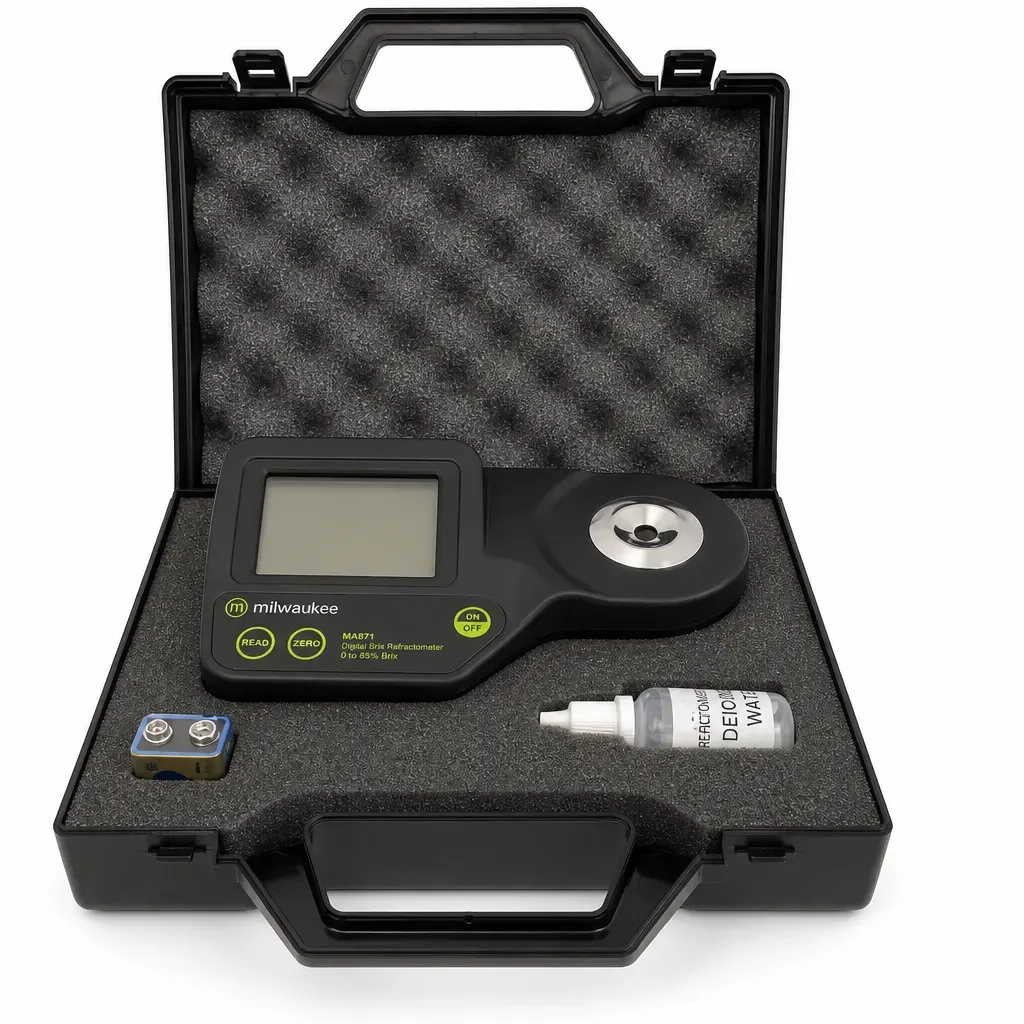
TL;DR: An automatic temperature compensation refractometer is a refractometer that automatically corrects Brix readings for normal sample temperature changes, so results are faster, more consistent and easier to trust in UK food, drink and quality control settings.
An automatic temperature compensation refractometer measures the sugar concentration or soluble solids in a liquid and automatically adjusts the reading to account for temperature variation. As a result, it gives a more reliable Brix result than a non-compensated model when samples are colder or warmer than the reference condition.
Small temperature shifts can distort a Brix reading enough to affect a batch decision, a goods-in check or a production release. Therefore, an ATC refractometer matters because it helps deliver faster, more dependable readings when working conditions are less than perfect.
For UK food production, drinks manufacturing, catering, laboratories and quality control teams, temperature compensation is not a minor feature. Instead, it is one of the practical differences between a result you can trust and one you may need to question. When a refractometer includes ATC, it adjusts readings to account for sample temperature variation, reducing manual correction and helping operators work more consistently.
At Milwaukee D, the focus is straightforward: digital Brix refractometers for faster, more reliable QC. Based on our testing of routine sugar checks in production-style workflows, instruments with ATC and a clear digital display reduce avoidable repeat measurements and improve consistency between operators. If you need a professional sugar refractometer with 0-85 Brix range, ATC and clear digital readings, this guide explains what automatic temperature compensation does, when it matters, and what UK buyers should check before choosing a model.
What Is the Quick Answer on Automatic Temperature Compensation Refractometers?
What it is: an automatic temperature compensation refractometer is a refractometer that adjusts readings for temperature changes, improving consistency and reducing manual correction.
Why it matters: Brix readings are temperature-sensitive, so ATC helps prevent avoidable errors during quality control.
Best use cases: food and drink manufacturing, catering, brewing, fruit processing, jam production and incoming goods inspection.
What to look for: a clear digital display, suitable Brix range, straightforward calibration, robust build and dependable support from a trusted UK supplier.
Milwaukee D fit: a digital Brix refractometer with 0-85 Brix range, ATC and easy-to-read results is well suited to professional QC workflows.
What Is an Automatic Temperature Compensation Refractometer?
An automatic temperature compensation refractometer is an instrument that measures how light bends through a liquid sample and then applies a temperature correction automatically, so the displayed Brix result is standardised more reliably.
Refractometers are widely used to measure dissolved solids in sugar-based liquids, usually reported in degrees Brix. In practical terms, that means checking sweetness, concentration or batch consistency in products such as juices, soft drinks, syrups, sauces, jams and other food preparations.
Without temperature compensation, the sample temperature can influence the refractive index enough to shift the reading. In a busy production setting, where samples may come from chilled storage, ambient preparation areas or warm process lines, that creates unnecessary uncertainty.
ATC reduces that problem. In other words, instead of asking the operator to calculate a correction manually, the instrument compensates for normal temperature variation within its specified operating range. Consequently, the workflow is quicker and more repeatable, with less room for human error.
How Does Automatic Temperature Compensation Work on a Refractometer?
What is the basic principle behind ATC?
Liquids change their optical behaviour with temperature. As temperature rises or falls, refractive index shifts, and a refractometer reading can move with it. ATC uses an internal temperature sensor and a compensation algorithm to correct the reading against a reference temperature, typically used for standard Brix interpretation.
What does the operator see during a reading?
In day-to-day use, the process is simple. You place a few drops of sample on the prism or sample well, allow the reading to stabilise, and the digital display shows the compensated result. Therefore, there is no need to consult correction tables or carry out mental arithmetic on the production floor.
Why does digital ATC matter in practice?
ATC is especially useful in a digital instrument because it pairs compensation with clear numerical output. As a result, it helps avoid two separate problems at once: temperature-related variation and ambiguity from reading a manual scale. For QC teams handling multiple samples, a digital Brix refractometer can save time while improving consistency between operators.
Why Is Temperature Compensation Important for Brix Readings?
Temperature compensation is important because Brix readings are temperature-sensitive. If the sample is warmer or colder than expected, the refractive index changes and the result can shift enough to affect process decisions.
UK production environments are rarely temperature-static. Goods may arrive from refrigerated transport, ingredients may sit in ambient stores, and test areas can vary significantly across the working day. For that reason, if you are checking sugar concentration in those conditions, temperature compensation is a practical requirement in any serious QC routine.
According to UK food safety guidance, food businesses should operate procedures based on HACCP principles. The Food Standards Agency makes clear that consistent control measures matter, and reliable measurement supports that wider framework. While a refractometer is only one tool within the system, dependable readings help teams document checks with greater confidence.
There is also a strong time and waste argument. The Office for National Statistics has reported sustained operational pressure on UK manufacturers and hospitality businesses in recent years. Therefore, reducing rework, rejected batches and unnecessary repeat testing remains commercially important. A more reliable instrument can support leaner decision-making when margins are tight.
Based on our testing and customer feedback across professional instrumentation use, UK buyers usually want the same outcome: a reading that can be taken quickly by different staff members and trusted without lengthy rechecking. An automatic temperature compensation refractometer directly supports that requirement.
When Should You Use an Automatic Temperature Compensation Refractometer?
Is it useful for food and drink manufacturing?
Yes. ATC is particularly valuable where recipes must stay within a defined concentration range. In juices, cordials, syrups and sauces, small Brix differences can affect taste, mouthfeel, yield and labelling consistency. Therefore, a compensated reading helps operators make more accurate adjustments during production.
Is it useful in commercial kitchens and catering?
Yes. In catering and foodservice preparation, ingredients are often tested at less controlled temperatures than in a formal laboratory. Consequently, an ATC refractometer helps chefs, development kitchens and central production units check sauces, preserves and sugar solutions more reliably.
Is it useful for fruit and produce handling?
Yes. Fresh produce testing can involve samples straight from storage, transport or processing. ATC helps smooth out the effect of those temperature differences, which is useful for incoming goods checks and ripeness or quality assessment based on soluble solids.
Is it useful in brewing and beverage work?
Yes. Where sugar concentration is part of process monitoring, automatic compensation can streamline routine checks. However, it does not replace a full quality system; instead, it helps the operator get to a dependable result more efficiently.
Should You Choose a Manual or Digital Automatic Temperature Compensation Refractometer?
A manual ATC refractometer can be suitable for basic checks, but a digital automatic temperature compensation refractometer is usually the better choice for professional UK QC work. The main reason is consistency: digital models reduce operator interpretation errors and display the compensated result clearly.
Manual units may still require careful handling of the scale and light conditions, whereas digital models simplify routine testing and staff training. As a result, digital ATC refractometers are often better suited to busy production, laboratory and goods-in environments where repeatability matters.
For Milwaukee D customers, that difference is especially relevant when teams need rapid, easy-to-read results across multiple batches or shifts. A digital model with ATC, a suitable Brix range and straightforward calibration is generally the more efficient long-term option.
What Should UK Buyers Look for in an Automatic Temperature Compensation Refractometer?
Is the Brix range suitable for your products?
First, check that the instrument covers the concentration range you actually test. For many food and beverage applications, a 0-85 Brix range is a practical choice because it spans low to high sugar products.
Is the display clear and easy to read?
Secondly, look for a digital display that gives an unambiguous reading. This is particularly useful in fast-moving QC settings where multiple people may use the same instrument across a shift.
Is calibration straightforward?
Calibration should be simple and repeatable. If routine checks are awkward, instruments are less likely to be used consistently. Therefore, ease of calibration is a genuine buying factor, not a minor extra.
Is the instrument robust enough for working conditions?
In practice, UK buyers often need an instrument that can cope with regular bench use in production or laboratory environments. Build quality, cleaning practicality and dependable sensor performance all matter.
Can you get support from a trusted UK supplier?
Finally, support matters. Buying from a supplier that understands UK applications, lead times and after-sales expectations can make ownership much easier, especially when the refractometer is part of a wider quality control process.
Frequently Asked Questions About Automatic Temperature Compensation Refractometers
Does ATC make a refractometer more accurate?
ATC helps make readings more reliable when sample temperatures vary within the instrument's specified range. It does not override poor sampling, contamination or missed calibration, but it does reduce one common source of error.
Does ATC matter if the room temperature is stable?
Yes, because the sample itself may still be warmer or colder than the room. For example, ingredients may come from chilled storage or a warm production line, so compensation remains useful.
Can an ATC refractometer be used for food quality control?
Yes. It is widely used for sugar-based liquids and soluble solids checks in food and drink production, including juices, syrups, sauces, preserves and related products.
Is a digital ATC refractometer better for multiple operators?
In many cases, yes. A digital display reduces subjective reading differences and helps teams work more consistently across shifts or sites.
Final Word
An automatic temperature compensation refractometer is designed to give a dependable Brix reading without the delay and uncertainty of manual temperature correction. For UK food, drink and catering operations, that means more consistent checks, clearer decisions and less avoidable rework.
If you are comparing instruments, focus on the practical essentials: ATC performance, an appropriate Brix range, a clear digital display, simple calibration and support from a knowledgeable UK supplier. For many professional users, that combination is what turns a refractometer from a basic measuring tool into a reliable part of everyday quality control.
Ready to try Milwaukee D?
Shop Now — £189.00