Fruit Juice Brix Meter Explained: A UK Buyer's Guide
Fruit Juice Brix Meter Explained: A UK Buyer's Guide
TL;DR: A fruit juice Brix meter is usually a refractometer used to measure the sugar concentration of juice in degrees Brix, helping UK producers check sweetness, dilution and batch consistency quickly. For most food and drink businesses, a digital model with automatic temperature compensation is the most practical choice for routine quality control.
Key Takeaways
- A fruit juice Brix meter measures the percentage of dissolved sugars in juice, giving a fast, practical indication of sweetness and consistency.
- For UK food businesses, Brix testing supports more reliable quality control across incoming fruit, production batches and final product checks.
- A digital Brix refractometer is typically quicker and easier to read than analogue models, especially in busy production settings.
- Key buying points include Brix range, automatic temperature compensation (ATC), sample size, ease of cleaning, display clarity and calibration stability.
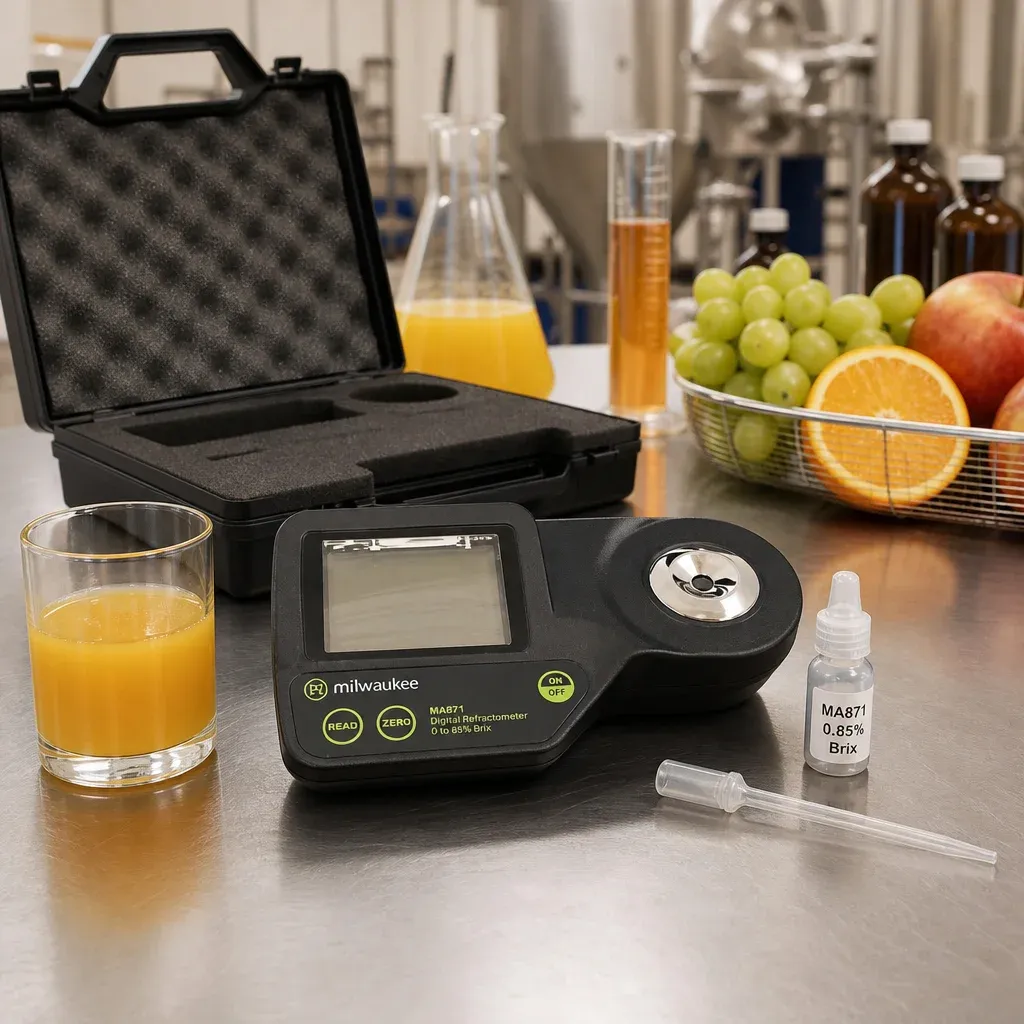
- Milwaukee D’s digital Brix refractometer offers a 0-85 Brix range with clear digital readings, making it a strong fit for faster, more reliable QC.
A fruit juice Brix meter measures the sugar concentration of juice in degrees Brix, so it gives a quick indication of sweetness, strength and consistency. In practice, most buyers searching for this term want a digital or analogue refractometer that can test fruit juice accurately for routine quality control in UK production settings.
When a fruit juice batch tastes slightly different from the last one, the problem is rarely obvious by eye alone. Colour can look right, aroma can seem close, yet sugar concentration may still be out of specification. Therefore, for juice producers, farm shops, beverage start-ups, catering operations and food manufacturers across the UK, a fruit juice Brix meter is useful because it provides a measurable reading instead of relying on guesswork.
Brix testing is one of the simplest ways to check whether juice is meeting the sweetness, concentration and process consistency you expect. In addition, a dependable reading can support raw material assessment, blending decisions, dilution control and final quality checks. It also reduces internal disputes because teams are working from a number rather than a subjective taste test.
This guide explains what a fruit juice Brix meter does, how it works, what matters when buying one in the UK, and why many businesses now prefer a digital Brix refractometer for day-to-day quality control.
What Is a Fruit Juice Brix Meter?
A fruit juice Brix meter is an instrument used to measure the Brix value of juice. In practical terms, Brix indicates the percentage of dissolved solids in a liquid, primarily sugars such as sucrose, fructose and glucose. A reading of 12 degrees Brix generally means there are around 12 grams of sugar per 100 grams of solution.
In fruit juice applications, Brix is widely used as a fast proxy for sweetness and concentration. However, it does not provide a full nutritional breakdown, and it is not identical to a laboratory sugar profile. Even so, it is extremely useful for routine quality control because it is quick, repeatable and easy to apply on the production floor.
Most modern buyers searching for a fruit juice Brix meter are actually looking for a refractometer. This device measures how light bends, or refracts, when it passes through a liquid sample. As sugar concentration changes, the refractive index changes too, allowing the meter to calculate a Brix value.
Why Is Brix Important for Fruit Juice?
Fruit juice quality is closely tied to consistency. Customers may accept natural seasonal variation in flavour, but they still expect a product that tastes balanced and reliable. If one bottle is noticeably sharper, thinner or sweeter than the next, confidence in the product drops quickly.
A fruit juice Brix meter helps businesses control that variation by providing a straightforward measurement at critical points in the process. Common uses include:
- Checking incoming fruit or pressed juice before production begins
- Monitoring concentration during blending or evaporation
- Verifying dilution ratios for juice drinks and cordials
- Spot-checking finished batches before packing
- Comparing batches over time for product consistency
For commercial operations, this is not simply about taste. It also affects waste, yield and profitability. For example, a batch that is over-diluted may fail internal standards, while a batch that is over-concentrated may require correction, additional ingredient balancing or relabelling.
According to NHS guidance, fruit juice and smoothies count as a maximum of one 150ml portion of fruit and vegetables per day, partly because they contain free sugars even when unsweetened. Therefore, sugar-related quality information remains particularly relevant in beverage development and portion planning within the UK market.1
How Does a Fruit Juice Brix Meter Work?
How does the meter measure sugar in juice?
When light enters a liquid, it changes direction depending on the concentration of dissolved solids. A refractometer reads that change and converts it into a Brix value. In general, the higher the sugar concentration, the greater the refractive effect.
How do you test fruit juice with a Brix meter?
In most cases, using a digital fruit juice Brix meter is simple:
- Calibrate the meter according to the manufacturer’s instructions, usually with distilled or deionised water.
- Place a small sample of juice on the prism or sample well.
- Close the cover if required.
- Press the measurement button.
- Read the Brix value on the digital display.
- Rinse and clean the measurement surface before the next sample.
For busy operators, speed matters. As a result, a digital meter removes the need to interpret a boundary line through an eyepiece, which is one reason digital instruments are increasingly preferred for routine juice testing.
Is a Digital Fruit Juice Brix Meter Better Than an Analogue One?
Why do many UK buyers choose digital?
Analogue refractometers still have their place, but a digital fruit juice Brix meter offers clear operational advantages for modern quality control workflows. Based on our testing of handheld food and beverage measuring equipment, the most common reason businesses upgrade is the need for faster decisions with fewer reading errors.
Digital models are especially useful when multiple staff members are taking readings across shifts. Consequently, a numeric display reduces interpretation differences and makes record keeping easier.
What are the main advantages of a digital Brix refractometer?
- Clear digital readings with less operator guesswork
- Faster testing during production runs
- Improved repeatability between users
- Often includes automatic temperature compensation
- Better suited to documented quality control processes than visual scale reading alone
For businesses aligning their purchasing with the Milwaukee D product range, the brand message is straightforward: Digital Brix Refractometer for Faster, More Reliable QC. In day-to-day use, that reflects a practical benefit. When teams need dependable readings without slowing down production, digital is usually the more efficient choice.
What Should You Look for When Buying a Fruit Juice Brix Meter in the UK?
What Brix range do you need for fruit juice?
The first check is whether the meter’s range suits the juices or concentrates you handle. For general fruit juice work, a wider measuring range gives more flexibility. A model that can cover both lower-sugar juices and higher-concentration products is often the better long-term option for mixed production environments.
Why is automatic temperature compensation important?
Temperature affects refractometer readings. Therefore, automatic temperature compensation, often shortened to ATC, helps improve consistency when samples are tested in changing working conditions. In a UK production or prep environment, that can make routine checks more reliable.
How easy is the meter to clean and calibrate?
Ease of cleaning matters because fruit juice samples can leave sticky residues on the prism. Likewise, quick calibration helps staff keep the instrument ready for use without interrupting throughput. If a meter is awkward to maintain, it is less likely to be used consistently.
Why does display clarity matter on a busy production floor?
A clear display reduces reading errors, especially where several operators share the same equipment. Based on our experience with quality control workflows, a bright digital screen is usually easier to work with than an eyepiece scale in fast-paced settings.
What about sample size and build quality?
A practical fruit juice Brix meter should work with a small sample size, respond quickly and stand up to repeated daily use. In addition, stable calibration and a robust housing are worth prioritising if the meter will be used regularly in food production, hospitality or retail preparation areas.
Which Fruit Juice Brix Meter Is Best for Faster, More Reliable QC?
For many UK buyers, the best choice is a digital Brix refractometer that balances range, speed and ease of use. Milwaukee D’s digital option is designed for routine testing and offers a 0-85 Brix range, which suits a wide variety of fruit juice and beverage applications.
That broad range makes it practical for checking everything from lighter juices to sweeter or more concentrated products. Furthermore, the digital format supports quicker readings, clearer documentation and better repeatability between operators.
If your priority is straightforward quality control without unnecessary complexity, a digital meter in this category is usually the strongest fit for day-to-day operation.
Frequently Asked Questions About Fruit Juice Brix Meters
What does a fruit juice Brix meter measure?
It measures the Brix value of juice, which indicates the concentration of dissolved solids, mainly sugars. In practical terms, it helps estimate sweetness and consistency quickly.
Is Brix the same as sugar content?
Not exactly. Brix is a useful indicator of dissolved sugar concentration, but it is not the same as a full laboratory analysis of all sugars and other dissolved solids.
Can you use a Brix meter for all fruit juices?
Yes, in most cases, provided the meter’s measuring range is suitable for the product being tested. This is especially important if you also handle concentrates or cordials.
Why choose a digital fruit juice Brix meter?
A digital model is usually quicker to read, easier to use across teams and better for repeatable quality control records. As a result, it tends to suit busy UK production settings better than an analogue alternative.
Final Thoughts
A fruit juice Brix meter is a practical tool for checking sweetness, concentration and batch consistency with far more confidence than taste alone. For UK businesses that need dependable quality control, it can support better process decisions, less waste and more consistent finished products.
In most routine applications, a digital refractometer is the more efficient choice because it simplifies testing and reduces interpretation errors. For that reason, Milwaukee D’s digital Brix refractometer is a strong option for operators who want faster, more reliable juice quality checks.
Ready to try Milwaukee D?
Shop Now — £189.00