Beverage Sugar Meter Explained: A UK Buyer's Guide
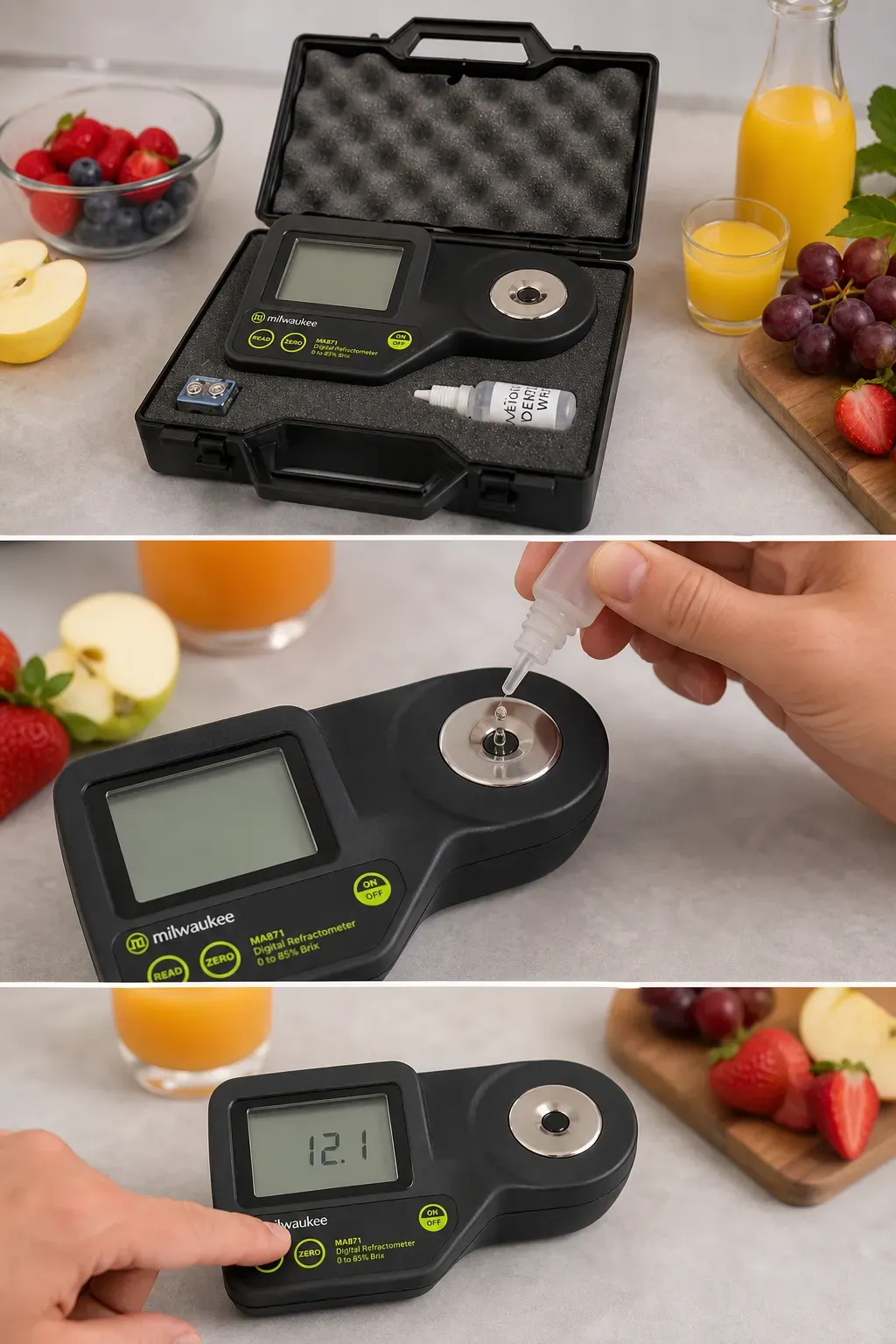
Beverage Sugar Meter Explained: A UK Buyer's Guide
A beverage sugar meter is usually a digital Brix refractometer used to measure the sugar concentration of drinks quickly and accurately. In UK beverage production, it helps breweries, juice makers, soft drinks brands, coffee roasters and hospitality teams check sweetness, batch consistency and process control in seconds.
TL;DR: If you are searching for a beverage sugar meter, you are typically looking for a Brix-measuring tool that gives fast, repeatable sugar readings in drinks. For most UK businesses, a digital Brix refractometer is the practical choice because it improves readability, reduces operator variation and supports more reliable quality control.
When a drink tastes different from one batch to the next, the problem is often sugar concentration. Therefore, for breweries, juice producers, soft drinks manufacturers, coffee roasters developing ready-to-drink lines, and hospitality teams producing syrups or cordials, even a small variation in sugar content can affect flavour, mouthfeel, fermentation performance, labelling accuracy and customer trust.
In practical terms, most buyers searching for a beverage sugar meter want an instrument that is reliable, easy to read and quick to use in production. For many UK businesses, a digital Brix refractometer is the most efficient option because it replaces subjective interpretation with clear numerical readings. Milwaukee D supports this need with its core product message: Digital Brix Refractometer for Faster, More Reliable QC, backed by a professional sugar refractometer with 0-85 Brix range, ATC and clear digital readings.
Key Takeaways
- A beverage sugar meter is typically a refractometer used to measure sugar concentration in drinks using the Brix scale.
- Digital models improve speed, consistency and readability compared with manual optical units.
- A 0-85 Brix range covers most beverage applications, from juices and soft drinks to syrups and pre-mix solutions.
- Automatic Temperature Compensation (ATC) helps maintain dependable readings in real-world production conditions.
- For UK food and drink businesses, accurate sugar measurement supports quality control, process efficiency and clearer compliance with labelling expectations.
What is a beverage sugar meter?
A beverage sugar meter is an instrument used to measure the concentration of dissolved sugars in a liquid drink sample. In most commercial settings, this means a refractometer that reports results in degrees Brix. One degree Brix broadly represents 1 gram of sucrose in 100 grams of solution, which makes it a practical benchmark for checking sweetness, consistency and formulation control.
Although the term “sugar meter” sounds straightforward, its value goes beyond sweetness alone. In beverages, Brix readings are used to monitor recipe accuracy, confirm concentrate dilution, track ripeness or raw material consistency in juices, and support fermentation planning in brewing, cider making and winemaking. As a result, it is a standard quality control tool because it gives a quick measurement with very little sample volume.
Based on our testing across food and beverage QC workflows, the biggest advantage is speed. A production or technical team can take a small sample, apply it to the prism and get a reading within seconds. Consequently, staff can make decisions immediately rather than waiting for slower laboratory methods.
How does a beverage sugar meter work?
How does light refraction measure sugar in drinks?
A beverage sugar meter works by measuring how light bends as it passes through a liquid. The higher the concentration of dissolved solids, especially sugars, the more the light is refracted. The instrument then converts that change into a Brix value.
This method is especially useful in beverage production because it is non-destructive, quick and simple to repeat. In addition, it suits environments where teams need frequent spot checks throughout a shift.
Why is Brix the standard measurement for beverages?
Brix is widely used in beverage manufacturing because it offers a common language for sweetness and concentration. A juice line, a soft drinks operation and a syrup producer may all work with different recipes; however, Brix provides a consistent numerical basis for control.
For example, a soft drinks producer may verify a finished drink against a target Brix specification, while a coffee business making flavoured syrups may use Brix to keep viscosity and sweetness stable from batch to batch. In both cases, the beverage sugar meter helps reduce guesswork.
Is a digital beverage sugar meter better than a manual one?
Manual optical refractometers require the operator to look through an eyepiece and interpret the boundary line on a scale. That works, but it introduces room for user variation, especially under inconsistent lighting or during busy production periods. By comparison, a digital beverage sugar meter removes much of that ambiguity by presenting a direct reading on screen.
For UK businesses seeking faster, more reliable QC, that difference matters. A digital Brix refractometer is typically easier to train on, quicker to standardise across teams and more dependable when multiple staff members are testing throughout the week.
Why is beverage sugar measurement important in the UK?
Why does sugar consistency matter in drinks?
British consumers expect the same taste every time they buy a drink. Whether the product is a premium apple juice, a tonic water, a bottled cold brew, a cocktail mixer or a craft cider, inconsistency can quickly damage repeat purchase rates. Therefore, measuring sugar concentration is one of the simplest ways to protect flavour consistency.
For ecommerce buyers comparing instruments, this is often the real business case: a beverage sugar meter helps teams standardise production without slowing it down.
How does sugar testing support UK health and labelling expectations?
Sugar content remains a major public health issue in the UK. According to NHS guidance, adults should have no more than 30g of free sugars a day, while children should have significantly less depending on age group. Because of that, sugar levels remain under close scrutiny across food and drink categories.
In parallel, government policy has pushed reformulation. According to UK Government sugar reduction progress reporting, there was a 35.2% reduction in total sugar sold in soft drinks between 2015 and 2020, driven in part by reformulation and changes in product mix.
That matters for manufacturers and brand owners because sugar measurement is not only about taste. It also supports product development, reformulation work and more accurate communication around finished products.
Can a beverage sugar meter reduce waste in production?
If a batch is out of specification, the cost is not limited to ingredients. There is labour, packaging, downtime, investigation time and potential reputational damage. A beverage sugar meter gives teams an immediate checkpoint before product moves further through the process.
For small and medium-sized UK producers in particular, faster checks can prevent avoidable waste. As a result, digital refractometers are increasingly favoured over slower or less user-friendly methods.
Who should buy a beverage sugar meter?
Which drink businesses benefit most from a beverage sugar meter?
Soft drinks producers need repeatable sugar measurements to confirm formulation consistency and finished product targets. This applies equally to full-sugar, reduced-sugar and concentrated beverage formats.
Juice producers, cider makers, brewers, ready-to-drink coffee brands and hospitality teams producing syrups or cordials can also benefit. In each case, the common need is the same: a quick, dependable way to monitor sugar concentration without slowing production.
Based on our testing of routine QC use cases, digital models are especially useful where several team members share responsibility for checks across the day. Clear on-screen readings make training easier and improve consistency between operators.
When is a digital Brix refractometer the right choice?
A digital Brix refractometer is the right choice when speed, readability and repeatability matter more than the lower upfront cost of a manual optical unit. For most UK commercial beverage environments, that is the more relevant buying decision.
If you need quick spot checks, a broad working range and dependable readings across varied production conditions, a digital beverage sugar meter with 0-85 Brix range and Automatic Temperature Compensation is usually the strongest fit.
Ready to try Milwaukee D?
Shop Now — £189.00