
Short answer: The best refractometer for grape harvest Brix in a UK vineyard is one whose documented range, accuracy and field routine match the sampling plan. Milwaukee specifies the MA871 for 0 to 85% Brix, with 0.1% resolution, ±0.2% Brix accuracy, a 100 µL minimum sample and automatic temperature compensation from 10 to 40°C. Those figures support must sampling, but they do not provide a universal harvest threshold. Ripeness decisions can involve factors beyond soluble solids, so record the block, sample method and Brix result, then interpret it through the vineyard's own harvest plan.
Match the meter to vineyard work
Milwaukee lists 0.1% Brix resolution, ±0.2% Brix accuracy, approximately 1.5 seconds per measurement and a 100 µL minimum sample. These are useful selection facts for repeated field samples. Resolution is the display increment; it should not be described as greater accuracy than Milwaukee's stated ±0.2% Brix.
| Published MA871 point | Vineyard meaning |
|---|---|
| 0 to 85% Brix | Documented measurement range |
| 0.1% resolution | Displayed Brix increment |
| ±0.2% Brix accuracy | Manufacturer accuracy statement |
| 100 µL minimum sample | Small prepared sample required |
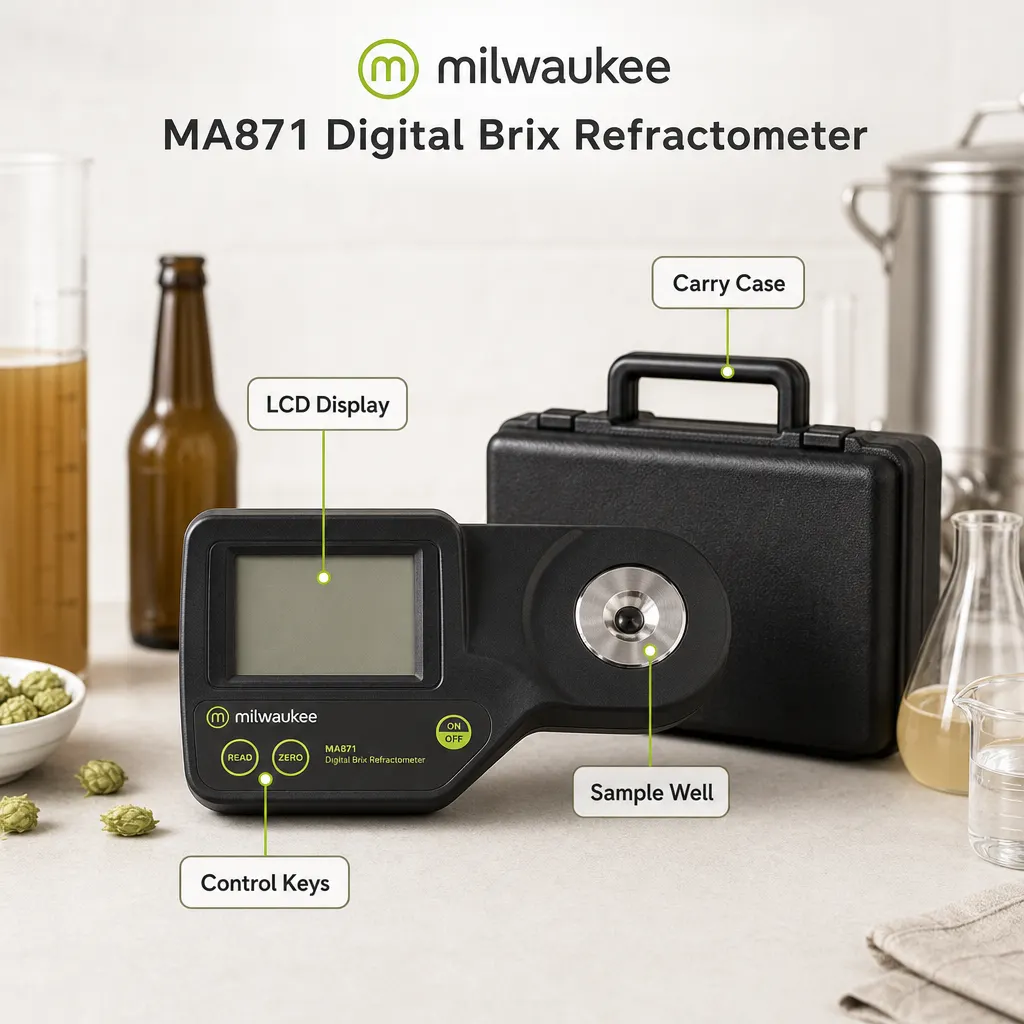
Build a representative grape sample
A vineyard result should identify the block or row, sampling date and sampling pattern. Crush and mix the selected berries using the vineyard's documented method before placing juice in the well. Milwaukee specifies the instrument method, but manufacturer does not specify a vineyard berry-selection protocol or the number of berries needed for a representative UK block.
- Define the block and repeatable berry-selection pattern before entering the vineyard.
- Prepare and mix the must sample without contaminating the instrument well.
- Cover the prism, take the reading and record the block, date and Brix result.
- Clean and dry the sample well before the next vineyard sample.
Use ATC within its documented boundary
Milwaukee states temperature compensation from 10 to 40°C and a sample-temperature range of 0 to 80°C. These are different specifications. ATC should not be presented as unlimited correction or as proof that a hot, cold or poorly mixed sample is comparable with every other reading. Keep sample preparation and timing consistent.
Limits on harvest interpretation
The MA871 reports Brix; it does not declare grape maturity, flavour balance, acidity, disease condition or the correct harvest date. Milwaukee does not specify a Brix threshold for English vineyards. Use the reading as one recorded input to a vineyard decision, and obtain viticultural or winery guidance where the harvest specification requires more than soluble solids.
Related guides and product details
Choose the MA871 when its documented Brix performance and cleaning routine fit the vineyard plan, but keep the harvest decision broader than one reading. Read Brix to Potential Alcohol for Homebrew: MA871 Limits for related guidance. Read Digital Brix Meter for Must Sampling in the Field for related guidance. Review the documented specification on the Milwaukee MA871 Digital Brix Refractometer product page before ordering.
Sources and safety context
- Supports range, resolution, accuracy, sample, response-time and temperature specifications. Milwaukee MA871 Digital Brix Refractometer.
- Supports calibration, measurement and cleaning procedure. Milwaukee MA871 Instruction Manual.