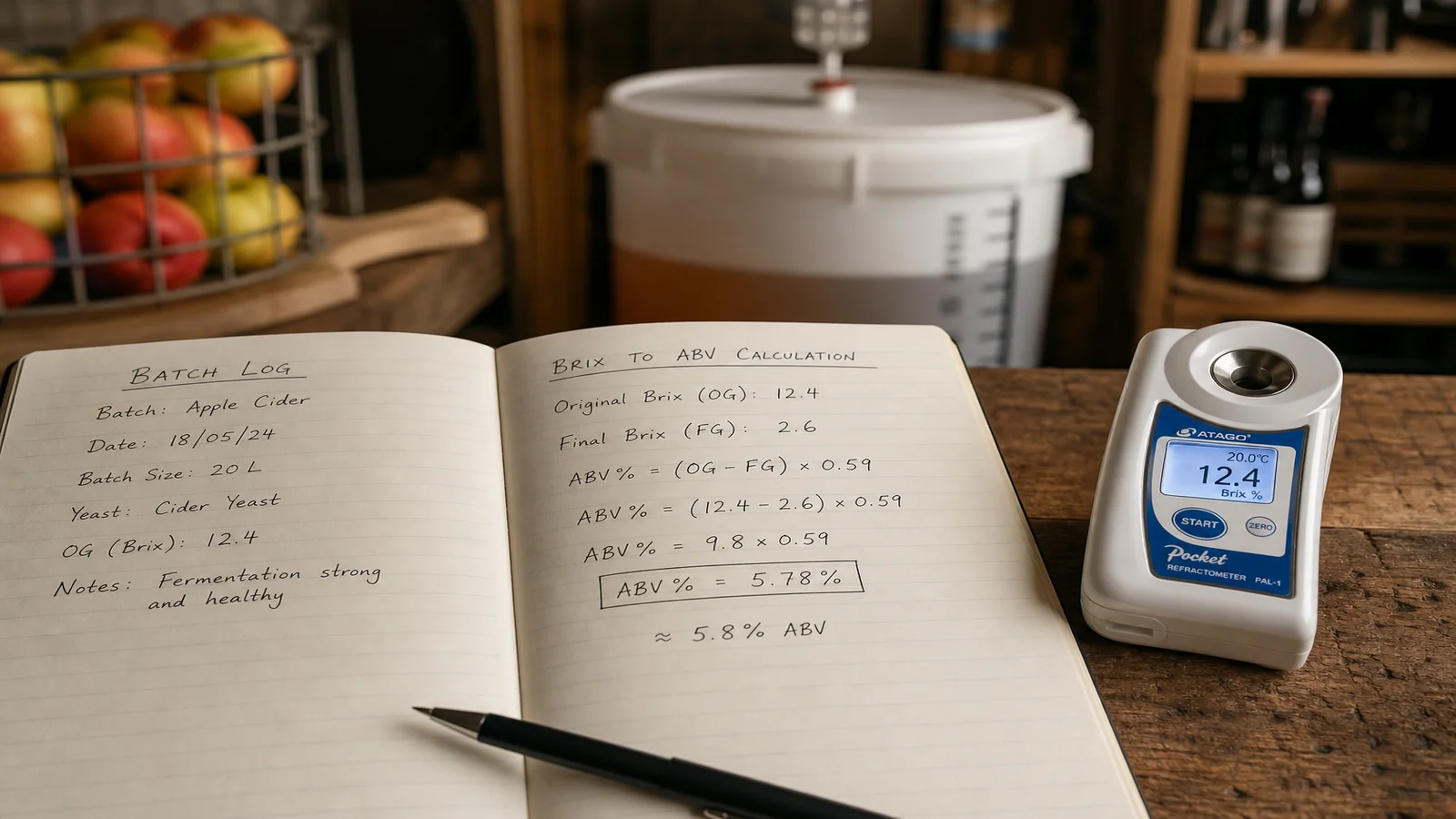
Short answer: A Brix to potential alcohol calculation for homebrew is an estimate built from a sugar reading, not a direct alcohol measurement from the Milwaukee MA871. Milwaukee documents the MA871 as a 0 to 85% Brix refractometer for sucrose-containing solutions. It does not list an alcohol scale, potential-alcohol mode, specific-gravity mode or built-in brewing conversion. Once fermentation introduces alcohol, interpretation also needs a method designed for that changed liquid. Record the original Brix and the calculation method separately, and do not present a predicted value as the measured alcohol content of the finished drink.
Key takeaways
- The MA871 measures Brix and does not directly display potential or actual alcohol.
- A conversion result is method-dependent and must remain separate from the original instrument reading.
- Post-fermentation refractometer values must not be treated as unchanged sugar-only measurements.
What the MA871 actually reports
Milwaukee specifies a Brix scale based on sucrose concentration, with a 0 to 85% range, 0.1% resolution and ±0.2% Brix accuracy. The official MA871 specification does not include potential alcohol, ABV or specific gravity. A calculator output is therefore an external estimate rather than another MA871 measurement.
| Value | Status |
|---|---|
| Original Brix | MA871 measurement |
| Potential alcohol | External estimate |
| Finished ABV | Not measured by MA871 |
| Specific gravity | No MA871 mode specified |
Keep an auditable homebrew record
A useful record preserves the displayed Brix value, sample stage, date, recipe and the exact conversion method used. Do not overwrite the original reading with a calculated figure. Milwaukee does not endorse a single homebrew potential-alcohol formula on the MA871 product page or in its operating manual.
- Calibrate and measure the unfermented sample according to the Milwaukee manual.
- Record the original Brix exactly as displayed with the batch stage.
- Apply only a documented conversion method appropriate to the recipe.
- Label the result as an estimate and retain the original input.
Why fermentation changes interpretation
Milwaukee describes the MA871 method for aqueous sucrose solutions. Fermented drinks contain alcohol and other dissolved material, so a raw later reading should not be interpreted as if the sample remained a simple sucrose solution. Manufacturer does not specify a post-fermentation correction for the MA871.
Limits of a potential-alcohol figure
A potential figure does not prove fermentation completion, finished strength, tax status, packaging readiness or safe consumption. The MA871 is not a medical device and its reading must not be turned into a health statement. Use the measurement and any later calculation only within an appropriate brewing method.
Related guides and product details
Use the MA871 to obtain the original Brix input, then keep any potential-alcohol estimate clearly labelled and separate from a finished-drink measurement. Read Digital Brix Meter for Must Sampling in the Field for related guidance. Read Digital vs Optical Refractometer for UK Food Production for related guidance. Review the documented specification on the Milwaukee MA871 Digital Brix Refractometer product page before ordering.
Sources and safety context
- Supports the Brix-only specification and numerical performance. Milwaukee MA871 Digital Brix Refractometer.
- Supports calibration and measurement procedure and the sucrose-method context. Milwaukee MA871 Instruction Manual.